
Scriptus ArcanaDiscover · Research · Re-imagine All demonstrations

Peoples · places · ideas

Soft as Silk,
Strong as Iron

Courage. Curiosity. Connection.

Meet the runes the Vikings carved. Crack a rune lock, spell like a carver, teach a toy machine to read, and raise a stone of your own.

Based on our experiment Raise a Stone, coming soon.

Begin the journey

Far lands.
Bolder questions.
A richer past.

Viking Runestones · a museum in five rooms

Soft as Silk,
Strong as Iron

In a Norse myth, the gods could not hold the giant wolf Fenrir with iron chains. So the dwarves made a ribbon, soft as silk, out of six impossible things, and it held him. This museum is about small things doing big work.

A voice from a thousand years ago

Who raised these stones?

Across Scandinavia, people paid carvers to remember someone they loved: a father, a wife, a brother, a friend. Most stones say who raised the stone, for whom, and how they were related. They were carved with an alphabet of just sixteen runes.

  1. f
  2. u
  3. þ
  4. o
  5. r
  6. k
  7. h
  8. n
  9. i
  10. a
  11. s
  12. t
  13. b
  14. m
  15. l
  16. R

Before you begin · how to visit

Try first, then find out.

Walk through the halls in order, or jump to any room. Every hall has something to try, a plaque to read, and a takeaway to keep. Open Tell me more for the details.

A rune
one of the sixteen letters of the Viking Age alphabet, the Younger Futhark.
A reading
the sounds and words a reader decides the runes stand for.
The apprentice
a toy computer reader in this museum that learns from flashcards.
The copycat
a toy reader that remembers famous words instead of reading them.

The halls · five rooms to explore

Read like a rune reader.

Each room holds one idea and one thing to do with your hands. Try it before you read the answer: that is how rune readers learn too.

  1. Cracked a lock
  2. Spelled by ear
  3. Taught the apprentice
  4. Set the trap
  5. Raised a stone

Hall I

Crack the Rune Lock

Vikings wrote with only sixteen runes. That was too few for all the sounds in their language, so one rune often stood for several sounds. Each lock holds an English word carved in runes. Turn every wheel to choose a sound for its rune, then try the lock.

Takeaway One rune can stand for several sounds, so every reading is a choice. A reader has to know which sound fits.

Tell me more

Each wheel holds the sounds its rune could stand for in the Viking Age, starting with the letter scholars use for it. The t-rune also wrote d, the k-rune also wrote g, the i-rune also wrote e, and the u-rune wrote o, v, w and y as well. The words on the locks are modern English carved the way a Viking might have spelled them, so you can check your answer.
Hall II

Spell It by Ear

There were no dictionaries and no spelling rules in the Viking Age. A carver spelled a word the way it sounded, and two carvers could spell the same word differently. Carve each name with the rune keys. Any spelling a carver could fairly have used is accepted.

Takeaway There were no spelling rules. One word can have several fair spellings, and a reader has to recognize them all.

Tell me more

Here a spelling is fair when every rune could stand for the sound it is used for: an o can be carved with ᚬ or ᚢ, an a with ᛅ or ᚬ, and a d with the t-rune ᛏ. On real stones a common word can turn up in dozens of different spellings, which is one reason reading runes takes practice.

Hall III

Teach the Apprentice

A computer isn’t born knowing runes. Our toy apprentice learns from flashcards: runes on the front, the word on the back. Show it one card at a time and watch how it reads a word it has never seen.

Takeaway A computer learns from examples, just like you. A reader that only counts sounds gets stuck where the whole word matters.

Tell me more

This apprentice is a toy. It only counts which letter each rune stood for on its cards, then reads every rune as its most common letter. Real AI readers learn from thousands of examples and look at whole words and sentences, which is how they can tell a d from a t when both are written with the same rune.

Hall IV

Trap the Copycat

Some computer readers have seen famous words so often that they remember them instead of reading. To catch one, scientists change a word and watch who notices. A reader writes the new word; a copycat writes the old one. Swap a word and see.

Takeaway Good science checks that you are measuring what you think you are measuring.

Tell me more

Before the swap you can’t tell reading from remembering: both readers write the famous words. Our experiment used the same trick on runestones. Personal names were swapped between stones, so a computer that had memorized a famous stone would give itself away by writing the old name.

Hall V

Raise Your Own Stone

Most runestones say who raised the stone, for whom, and how they were related. Fill in the names, then carve your own stone in the sixteen runes.

Takeaway Runestones were made to be read. Someone paid a carver so that everyone who passed by would remember a name.

Tell me more

This stone spells modern English with the sixteen runes, letter by letter. Real stones were carved in Old Norse, and most follow the same pattern: someone raised this stone in memory of someone, followed by how they were related. Letters the alphabet lacked borrowed another rune: d uses the t-rune, e the i-rune, g the k-rune and p the b-rune.

On your way out

Why it matters.

Three ideas to take home. Tap a card to turn it over.

The full experiment, with its results, is coming soon. See what’s coming

Credit plaque

With thanks to the scholars.

Everything in these halls is general knowledge about runes: the sixteen runes of the Viking Age, the sounds each could stand for, and the way memorial stones were usually worded. The English words, the toy readers and your stone are modern, made for this museum.

Real stones, and the readings runologists have made of them, will join the halls when the full museum opens.

Back to the entrance
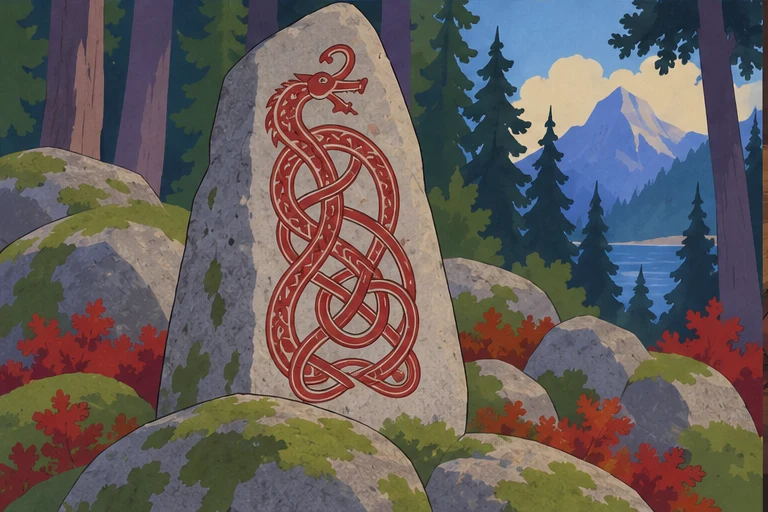
Illustrated runestone among forest rocks